15 minutes
Car Crashes
The trees are paint. Aim the car at a house and you drive in one wall and out the other. This lesson makes the roadside solid, and makes a corner hit spin you the way a real crash does.
Push and lever arm
Push a door near its handle and it swings open. Push it right beside the hinge, just as hard, and it barely moves. A push turns a thing by the push times its lever arm, which is how far to the side of the middle the push lands. Push straight through the middle and the arm is 0, so nothing turns.
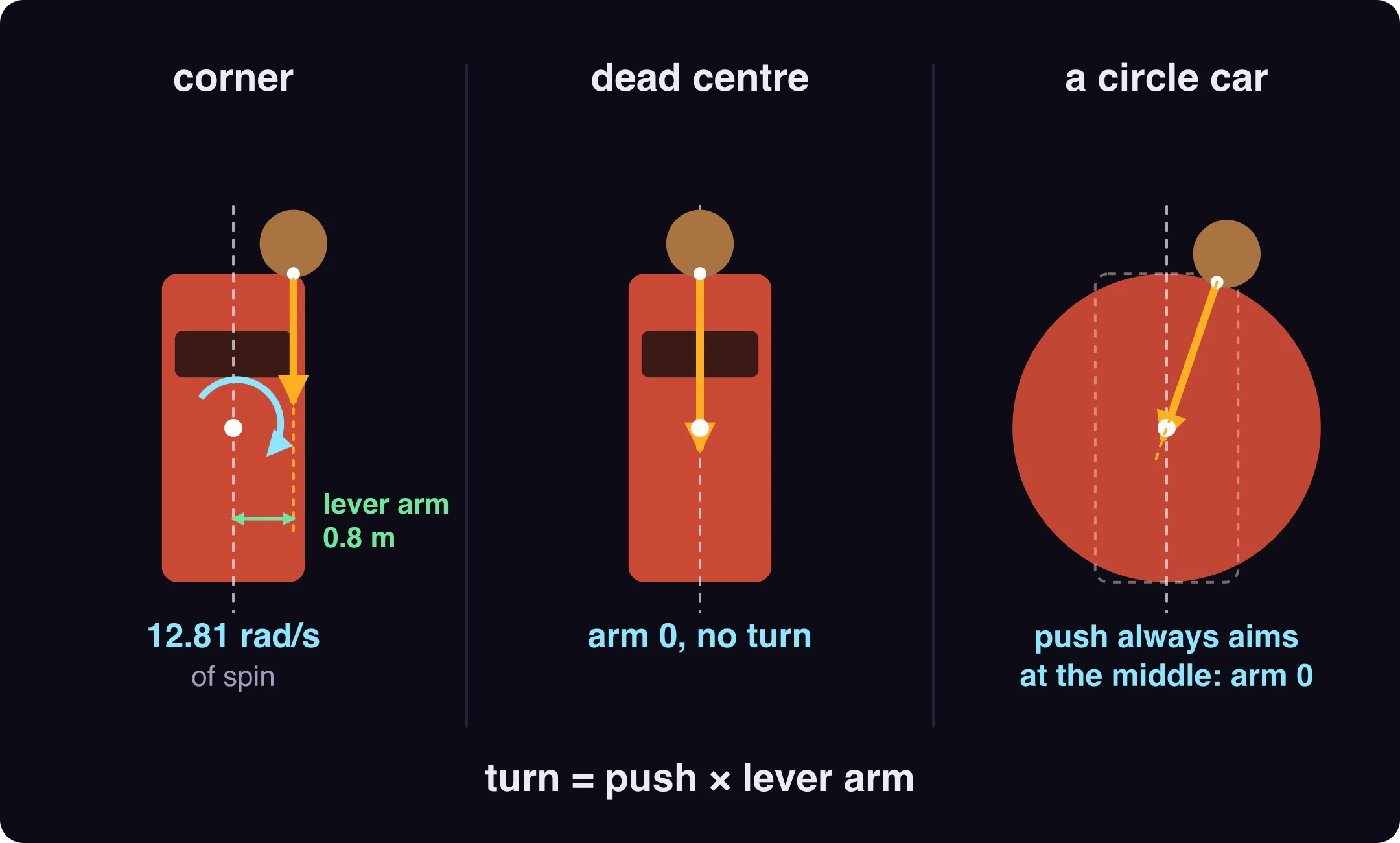
A crash is one sharp push, j, along the line n where the two things meet. In words: the closing speed, with a little bounce added, divided by how hard the two things are to shove and to turn at that spot:
v_n is how fast the two touching points close along n, and e is the bounce. The bottom adds up how hard each body is to move: 1/m to slide it, and (r⊥·n)²/I to turn it. There r⊥·n is the lever arm, and I says how hard the body is to spin. A tree never moves, so its two parts are 0. The second line turns the push into Δω, the change in spin.
Continue reading
Unlock the Full Course
Every lesson, the runnable examples, and the finished build — yours to keep.