By Lawrence
5 minutes
5 minutes
Galileo Was Right, Nearby
School says a thrown ball flies a parabola. Our balls fly ellipses. Good news: nobody is wrong. It depends how far you throw.
Galileo's parabola
Near the ground, we usually pretend two things. Gravity always points straight down, and it never changes strength. Then a ball fired sideways drops ½·g·t² while it flies v·t forward. That's Galileo's parabola.
Our ground is 0.7 below the muzzle, and g is the pull at the muzzle:
Both pretend-rules are a little wrong, and they're wrong in opposite ways:
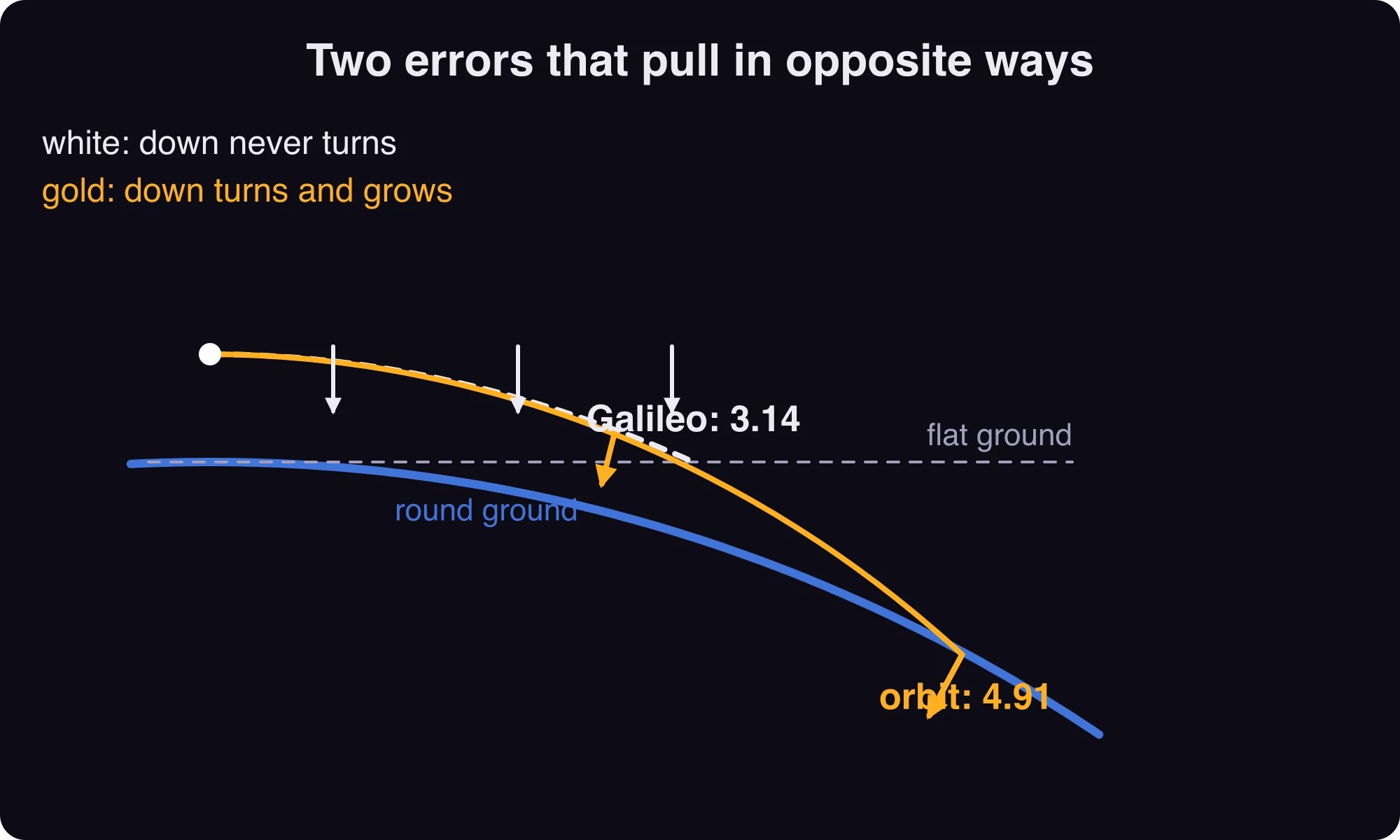
- The real ground curves away. That lets the real ball fly farther.
- Real "down" keeps turning toward the centre and getting stronger. That brings the real ball down sooner.
At low speed the second one wins. At higher speed the first one wins:
The two errors cancel out exactly at speed 2.567.
Continue reading
Unlock the Full Course
Every lesson, the runnable examples, and the finished build — yours to keep.
$9one-time
=