

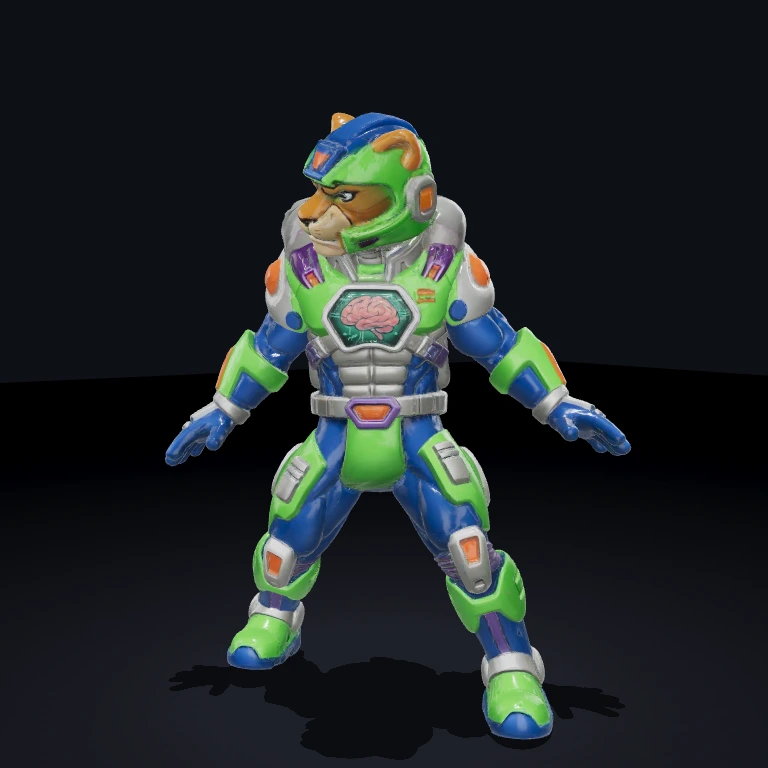
BallPursuit
Keeps a team of AI players from dogpiling the ball: only the nearest few chase, the rest hold station.
What it does
BallPursuitSystem runs every entity carrying a BallPursuitComponent. Each frame it groups the matched entities by TEAM — the suffix of a member's first team: tag (team:Red → Red); an untagged entity is its own one-member group — then reads each member's and the ball's world position through the renderer adapter (a sibling MeshPrimitive handle → getMeshWorldPosition, exactly the way AIInput and AIGoalSeek read positions). The pure core (BallPursuit.core) ranks a team's members by squared XZ distance to the ball and marks the chaseCount nearest as chasers; everyone else holds. For each member the System emits the SAME movement input a keyboard or AIInput would — input.movement.vector (MovementInputEvents.SET_MOVEMENT_VECTOR, never hardcoded) — a unit vector toward the ball for the chasers, {x:0,z:0} for the holders. Movement (physics-velocity mode) executes the intent, and AIZone — kept on each holder — tethers it back to its third of the pitch. The vector is re-emitted only when it changes (consumers latch the last value), and ballPursuit.decisionChanged fires for debuggers the frame a member's chase decision flips.
Use it in a scene
A scene is just data — a list of entities, each with its components. At startup the SceneLoader turns this JSON into a live world; edit the file and reload to rebuild it.
Fastest path
Pulls this exact scene into your project and runs it — no copy-paste. Add --all to grab the components and assets it needs too.
Or build it from scratch with the bjs CLI:
- 1Scaffold a project
World, renderer, and dev server — ready to run.
- 2Install dependencies
- 3Add BallPursuit
Copies its source into src/ so the scene resolves.
First time? Run bjs login once.
- 4Paste the scene into src/scenes/arcade-room.ts and run
SceneLoader builds the world from the JSON; reload to rebuild.
Props
targetEntity(string, default"Ball") — id of the ball entity every team member chases; the System looks up its mesh world position each frame.chaseCount(number, default1) — how many of a team's nearest members may chase at once; the rest hold. Floored and clamped to>= 0; a value past the member count just means everyone chases.
Events
- emits
input.movement.vector(MovementInputEvents.SET_MOVEMENT_VECTOR) —{ entityId, x, y, z }per member: a unit vector toward the ball (yalways0) for the chasers,x:0, z:0for the holders. Re-emitted only when the vector changes. This is the exact event AIInput and the keyboard emit, so Movement can't tell them apart. - emits
ballPursuit.decisionChanged(BallPursuitEvents.DECISION_CHANGED) —{ entityId, team, chasing, moveX, moveZ }the frame a member's chase decision flips. Debug/viz only; no gameplay system needs it.
BallPursuit consumes no events — it is a pure decision producer.
Dependencies
MeshPrimitive — supplies the mesh handles the System reads world positions from (each member's and the ball's). A member whose mesh handle isn't created yet is skipped that frame.
Movement — the consumer that turns the emitted input.movement.vector into motion; run it in physics-velocity mode so the vector drives the body.
AIZone — keep it on each member so the holders (and chasers that leave their third) are tethered back to their zone instead of drifting toward the ball.
Notes
- The team's
targetEntityandchaseCountare read from the first grouped member's component each frame, so set them consistently across a team. - Ranking uses squared XZ distance — the pitch is treated as flat,
Yis ignored. Ties break byidlexicographically, so the same member always wins a tie: the decision is deterministic and independent of entity order. - A chaser standing on the ball (distance under
1e-6) gets[0, 0]— there's no direction to move. - An untagged entity is its own one-member group keyed by its id, so at
chaseCount1 a solo AI always chases — team tags only matter when two or more members share one. - With
chaseCount0, no member of that team ever chases; every member is emitted{x:0,z:0}and left to its AIZone.


